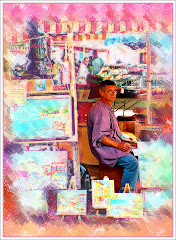
Wednesday, October 8, 2008

Ted Myers Sings the Song of the Street in San Diego

“My wife died,” remembers Ted Myers. “I’d always been into photography and curious about the homeless. I decided to combine both of them. Even though I still had three kids to raise on my own and a painting business, I still needed something to do with my time.”

What do you do when you see a homeless person? Dig into your pocket for a buck or two? Maybe you look the other way. (My life changing encounter with a homeless person in NYC is here: http://photoshopbasicsin6hours.blogspot.com/2008/07/photographing-street-people-in-new-york.html) Maybe you openly glare at them. If you’re San Diego’s Ted Myers, you sit down, spend time with them and take their portrait. This is why we've chosen him as our third flickr profile.

Myers has great empathy for the homeless. The first time I saw his work on flickr, I was blown away by the open joy on the faces, the wide-open smiles and this photographer’s passion for his subject that was a palpable presence on the other side of the lens.

Myers has good reasons for being empathetic. “Before her death, my wife was mentally ill. She suffered from drug and alcohol addictions. I used to think about that a lot. I used to think she would become homeless if I wasn’t there to take care of her.”

You won’t just see photos on Myer’s flicker Photostream. You’ll hear the stories they tell and somehow that makes the images more vibrant. I think it’s part of a bridge Myers is attempting to build between the streets…and you.


The woman in the image above is called the Christmas Tree Lady. Why? Myers says last Christmas she set up a tree on the sidewalk and all the homeless people decorated it. Isn't that amazing? The city had to take it down. Can you see the beauty of this story in her eyes?

See the negative space Myers has built into his portrait. Look at her eyes and TRY to tell me you don’t see something special there. Is this a woman who could possibly build Christmas memories for scores of homeless people?

I had to know how Myers connects so strongly with his subjects.

“The trick is all in the photographer personality,” he says. “The dollar may get you in the door. But after that, if you want their story, I find you have to share something with them. They like that. So I tell them about my wife. Then they really start to open up to me.”

You expect that homeless people understand tragedy. But do you expect them to smile? Laugh?

“The homeless have great features. Their faces make great close-ups. But I want this to be positive. So I always ask them to smile for me,” he says. “And I give them a dollar for their picture.”

See the life. Enjoy the detail built into every portrait.

Have a look at this man’s fingers. You’ll see nicotine stains. More than that you’ll see chunks of these fingers are missing. True to form, you’ll also see him throw his head back and laugh a few frames further down on Myer’s Photostream.


You don’t always need to see the face to understand the subject of a portrait. This guy has one treasured possession. He cradles his harmonica in scarred dirty hands. A portrait specialist like Myers is able to make those hands talk.

Looking at the image, do you have a sense for the man? What sounds do you think come out of that instrument when he raises it to his lips? Perhaps more telling: what do you think HE hears when he plays? I love the sensitivity of this image.


The man in the above image weighs 90 pounds now. He has diabetes. “He used to live in Las Vegas. But a guy lit him on fire while he was sleeping. His shoes melted onto his feet and he ended up losing a toe,” writes Myers. “He likes San Diego much better.”

“I want my portraits to be so close up you can see right into their eyes or hopefully even into their soul. But sometimes you can’t be too close or you won’t be able to see their big beard or wild hair.”

There’s no story that goes along with this one. It's my favorite shot from Myer’s Photostream. And I think that’s just as well because when I look at this face I feel a wellspring of emotion inside. I don’t know why exactly. There is a resoluteness to the face. There’s hope and a gut-level understanding of defeat. There’s intelligence and a very specific beauty as well.

“When I’m feeling depressed, sometimes I go downtown, just to talk with the homeless. For some reason, it makes me feel better,” says Myers. “They are great people and I love them.”

We know, Ted. We know.

Spend a few minutes with Ted’s friends on his flickr Photostream: http://www.flickr.com/photos/22000114@N05/

NOTE: All photos in this blog segment are by Ted Myers and are used with his permission. He reserves all rights.

Tuesday, October 7, 2008

Fabio's Fabulous Roma

I’d been in Rome about two hours and I was learning what “jet lag” truly means.

My wife and I dropped our suitcases off at the hotel, grabbed our cameras and headed out. When we get to a new city, we try to find one of those double-decker busses that take tourists around to see all the sites. We’ve found this to be a great way to get oriented and plan the places we are going back to.

On this particular morning (which was the middle of the night as far as my body was concerned) I admit that I was listing to one side. But then the bus turned a corner and I had one of the most powerful travel experiences of my life.

I was face to face with the Coliseum.

I remember the fog in my brain clearing instantly – and being completely overwhelmed. This wasn’t a Hollywood set or some tacky theme decoration. This was THE Coliseum. Gladiators fought here. Gala competitions were run here. Guys who ruled the world came here.

My memories of Rome all meld together. We’d be up and out before the sun rose. We’d walk the entire day, walk until our feet burned and then walk some more. There is such a casual beauty in Rome. Touchable history and fascinating people.

Fabio, the second flickr artist I’d like you to meet, says his Rome is something altogether different.

“Already the monuments of Rome are among the highest expressions of architectural history,” he says. “They are photographed by almost everyone. But what about the people who live here? Who sees them?”

Fabio does. He lives in Rome. He’s a barman and a web designer. He’s also one of the finest street photographers I’ve ever seen. We had a long chat the other day, talking about his passion for street photography.

“I love the portraits on the street,” he tells me. “Photographing people in their daily life, I manage to communicate the beauty and complexity of life for everyone. Most everything is spontaneous and natural. Everything is more beautiful, like life itself.”

Here’s another star of flickr that doesn’t have any difficulty communicating his passion for life, and the vibrant tableau around him.

We invited Fabio to share some of his favorite images. His absolute favorite is at the top of this blog. It’s of a woman looking to the east. When I asked him what made it his favorite, I found the nuances of what he discussed fascinating. He talked, not only about the direction the woman is looking, but also the things he chose to leave in the background: the crossed legs, the people – all the busy life going on around this very still looking woman.

When you look at Fabio’s work, you need to pay attention to the things he has included in the image. Yes. The people are fascinating but the beauty of this work to me is that they are all captured in the context of where they are in that exact second. And where they are has a tremendous impact on the overall image.

“You can stop the memories of life with an image,” he explains.


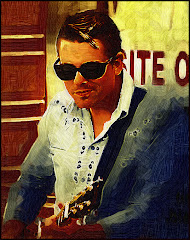
He wanted you to see this violin player as well. Have a good look at the artful cropping here. Many artists would have brought the crop in tight on the subject. Fabio chose to include the textured wall and to place the subject off to one side. What’s he saying? I think he wants us to know where this charming man comes from.

No one poses for Fabio.

“My photos are stolen,” he admits. There’s no further explanation forthcoming. Actually, when you think about it, no explanation is necessary. My sense from having talked with him is that Fabio isn’t interested in taking the same photos others do. He wants people in his images. And he wants them raw.


Does it get much more raw than a mother’s love? As you look at this image, try to reconstruct what it was like to stand there. If you were Fabio, how would you have composed the image? Here the mother is holding her child, attentive. This is a particularly eloquent image because you don’t need to see her face to know what’s happening in her heart. The child holds your attention with its eyes. It is a masterpiece of composition.


Here is an honest streetscape. The image is titled “How to Shoot a Wedding.” Here’s an alternate title: “How to Shoot a Streetscape.” Fabio’s fascination with people comes shining through in this image. The couple kissing are the subject, only because they are the focus of all the other people’s attention. Fabio doesn’t care about the kiss so much as he cares about showing us how other people react to it. Some smile. Some look away. What do you suppose the woman in the backpack is feeling? How about the couple holding hands?

A great streetscape poses questions like this and give the viewer great material for dreaming themselves into the image.


I wanted to finish with my personal favorite from Fabio’s Photostream. It’s entitled “Where the Hell is Jack Sparrow?” Again you will find the outstanding use of negative space and texture to put the subject into his environment. For me the image is all about crisp focus and that perfect instinct for the exact right time to take the shot.

Post-production isn’t a big part of the job for Fabio. “Ten minutes max,” he says. “I work on the contrast, the crop and the tone.”

At this point I am willing to bet fifty bucks that, as he typed this response to my question from his home in Rome, that he shrugged. My impression is that this is not an artist who is about working in the studio, or slaving over a hot computer.

This is a guy who is all about the street and experiencing the rich life that provides the heartbeat of one of the world’s great cities.

I love the mental image I have of Fabio creeping through the streets of Rome, camera in hand, looking for the picture that tells us a story, an image that shares what his Rome was like today.

Have a look at his flickr Photostream: http://www.flickr.com/photos/jeyh/

All Photos in this blog segment are by Fabio Jey-Heich and are used with his permission. He reserves all rights.

Monday, October 6, 2008

Tuscany MAGIC from Alessandro Ornelli


I spent a day in Tuscany. When I left, part of my heart stayed behind. We are planning a trip back to that wonderful region because a handful of hours simply wasn’t enough. Actually, I don’t think a year…a decade...or even a lifetime would be enough.

Tuscany is everything you imagined it to be and much more. The countryside is a perfect canvas for all artists. It inspired the artist, Michelangelo and birthed the incomparable singer Andrea Bocelli. It’s where you will see vineyards and history and the kind of countryside you thought could be found in storybooks.

It’s also where Alessandro Ornelli makes his art. Alessandro lives in Toscana. By day he is a PC technician but when he packs up his camera and heads out for the fabled countryside of Tuscany, he’s on his way to becoming one of the top graphic artists on flickr.

He is absolutely one of my all-time favorites.

I wanted to start this series of articles with Alessandro because the first time I saw his work, it took my breath away. I mean it. I saw an explosion of colors and light and I distinctly remember my jaw dropping as I sat in front of my computer having one of those “oh my God” moments every photographer hopes to inspire with his or her work.

It’s difficult to speak with Alessandro. His English isn’t good…and my Italian (beyond phrases like “Where is the red dog radiator banana located?” and “Please, madam, may I have three of your large green ears?”) isn’t much better.

We had to do all our talking through translators.

But look at these images and try to tell me Alessandro has a hard time making himself understood. I dare you.

“I love clouded, dramatic skies,” Alessandro writes. Okay. He didn’t have to tell us that. Both of the images he selected to be shown to you feature those huge Italian skies. Up top is one of his favorites. The Italian title translates to “Rain Threatens.”

You need to have a look at this image’s full size so click on it, spend a minute or two looking at it (and wishing you’d taken it…because I sure do) and then click on the “Back” button and meet me back here.

First, let me draw your attention to the leading line. Alessandro crops his image so those lines lead right to the sky. Open the picture again and have a look. As you look at the image, you will more than likely find your eyes following the furrow directly to that fabulous sky.

There are three beautifully ordered color grids being used here: the foreground is this awesome earthy brown. To the sides and the middle is vibrant green. The sky is comprised of varying shades of grey and black.

You need also to watch and see how this artist has used light. There’s light in the clouds as well as two lines defining the break between the brown earth and the green middle ground. See how he has used light to create that division?


Light plays and even bigger role in the second canvas Alessandro chose to show to you. This is the effect we have all seen and find very difficult to replicate. My wife and I call these “God rays” – bright lances of sunlight breaking through the clouds and shining perfectly on the earth below.

There are two really interesting things about this image to me. First: it has to be about 85% sky. The artist has decided the light and texture of his work are what he wants you to see. Where the first image started your eye at the bottom of the shot and then led you to the clouds – this image starts with your eye wandering around those wonderful dramatic clouds and then riding the rays of light down to the ground. In this image, earth is more of an afterthought…and, with a sky like this, why shouldn’t it be?

Look at the colors: strong greens and blues and whites. Bold and so very lovely.


This is my personal favorite. I chose it from Alessandro’s Photostream to share with you. I looked at this for a very long time the first time I saw it. The English translation is “The Party Ends.”

Do you see a continuation of what makes this artist truly exceptional? The sky, the perfect textures and the LIGHT – so lovely that it almost hurts your eyes. One lone umbrella remains and the people have vanished. The clouds are reflected in the water, the sand is textured with lines that lead to the water and then onto the sky. To me, this work is incomparable.

Alessandro says he spends about half an hour on each HDR image and shoots about 60% of his work in HDR. There’s a deftness, confidence and skill about his work, isn’t there?

I wonder how many Tuscany businessmen have watched him working on their PCs and had no idea who he was…or the awareness of beauty that waits within him.

Alessandro Ornelli’s flickr photostream can be found at http://www.flickr.com/photos/10235766@N08/

Pop by for a look. Who knows? You just might learn something.

I certainly did.

NOTE: All photos in this blog segment are by Alessandro Ornelli and are used with his permission. He reserves all rights.

"flickering" Thoughts

I’ve been playing around on flickr for the past while. For those who don’t know, flickr is a photo sharing website with teeming millions of photographers.

Some are scary good. I’ve seen utterly remarkable Photoshop and Photography work.

I’ve also seen some really awful stuff: snapshots of vacations, "cute pet" pics, endless wedding and family reunion photos.

(My photostream, loaded with travel and Photoshopped stuff is here: http://www.flickr.com/photos/41659872@N00/ in case you want to go there and begin writing wild notes of praise and send me blank signed checks.)

Times at my company have been really busy – which explains why I haven’t been around much. It’s not that I don’t think of you guys. But it takes me quite a while to put together a reasonable blog and time has been a real luxury lately.

But back to flickr for a second. Here are a couple of thoughts:

1) We are talking about a site that is as much about politics and networking as it is about the photos. Those who are well-connected get a TON of immediate response to their work.

What is “response?” People can “comment” on your photo. They can also choose to make your photo a “favorite.” Or they may make you a “contact” – which means they want to have constant updates on your work. The "genuine" compliments are the latter two.

My issue with this is that no one really seems to want advice. The comments are unstintingly positive. If people really wanted to hear what you think, they would say so. Read through the comments on pictures and try to find one…just ONE…that has a real suggestion for how to make the image more effective.

2) The awards are mostly meaningless. Since many flickr groups are intent on spreading their name around, there is a tremendous emphasis on giving out “awards.” As an example: some groups will demand that if you post one of your pictures, you are expected to make group “awards” to at least two other pictures. (“Awards” are codes you cut and paste from the sponsor group.)

The result, somewhat predictably, is that there are tons of awards given. This means that people aren’t really looking for “award worthy” work. They are looking for likely candidates to dump awards on. Not the same thing. Many people cut and paste awards and make no comment at all.

I think this leads to “fickr fever” – a condition where the patient is unable to sleep for fear of missing even one positive comment the very instant it arrives. The patient is constantly trying to cook up new ways to curry the favor and attention of other flickrites.

I’ve created my own award that I give to work I genuinely respect.

2) BUT there is a mind-blowing variety of material available on flickr. I’ve learned a LOT just from looking at the hundreds (maybe thousands) of photos. You see how different artists approach the same topic, how they visually depict various ideas and concepts.
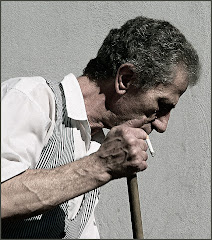
You’ll see illustrations and Photoshop. You’ll see photography and snapshots, landscapes and portraits. You’ll see photographs from all around the world of interesting people doing interesting stuff.

This is probably the very best reason to check flickr out. The compact exposure to all kinds of new art and visual “muscle” is candy for anyone’s eye. There are outstanding artists on flickr.

3) It’s interesting to see what people comment on…when they do comment. A great photograph HAS to be about more than a great subject. Everyone likes to see cute kittens, pretty girls and fabulous sunsets. These images really draw tons of comments on flickr.
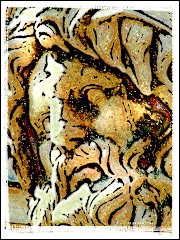
But often it’s a lousy photograph of a great subject that also draws comment after comment. Sure. It’s a cute kitten or a lovely girl. But often it’s a badly composed or poorly exposed image. Sometimes the images are over-processed. A great subject in a terrible photo is still a terrible photo.

I am astounded at how often the viewer chooses to overlook this stuff and “oooh” and “ahhh” about the subject instead. Reading the comments will give you a great insight on how your image might be viewed by its audience…an audience you never meet.

4) The absolute “proof in the pudding” about all things flickr is the answer to these questions: “Has being there made me a better artist? Do I think about the things I have learned from other people at flickr? Has the bar for my own work been set a little higher?”

The answer to all three questions, for me anyway, is “yes.”

So I am planning to devote the next few blogs to discussing the work of some of the exceptional artists I have found on flickr.

Stick around. It’s going to be interesting!

Sunday, September 28, 2008

See you later, Butch


Paul Leonard Newman
(January 26, 1925 – September 26, 2008)

It's a rare and wonderful thing to catch a glimpse of Hollywood royalty. And it's even better to have the opportunity to photograph them.

It makes me sad to hear of the death of Paul Newman.

My sympathies go out to his family, his friends and his fans. My encounter with this man was brief...but memorable.

In the very short time that our life paths intersected, I found him to have Sundance's smile, Luke's cool and Fast Eddie's flash.

He made me smile and he blew a kiss to my wife.

The last time I saw him, he was puttering off into the sunset on a red scooter and waving good-bye over his shoulder.

That's how I will remember him.

It's here on my blog: http://photoshopbasicsin6hours.blogspot.com/2008/06/stalking-paul-newman.html

My sympathies go out to his family, his friends and his millions and millions of fans.

It was good to know you, Paul.

Safe journey.

Paul Wins the Grand Prix


Thursday, September 18, 2008

Secret Worlds

There’s a secret out there. You can find it if you simply take a second to look over an occasional hill. Usually it’s in a place the rest of the world is only marginally aware of, the kind of place people cease to see after a while.

But it’s there.

There are people in these secret worlds as well – but they are the kind of people you only see only out of the corner of your eye as they melt into the background. The years have made them experts at disappearing, and the selective perceptions we (on the other side of the hill) have developed makes it easier still for us not to see them.

Sheree and I went to one of these places last night.

The hill you have to look over is in a neighborhood formerly occupied by the military. It’s at the end of a nameless street. Watch carefully because, as with all enchanted places, you will miss the flash of color it offers if you aren’t watching for it. It’s there for a just a second and then it’s gone.

We were a fellowship of three: Sheree was taking one of her photography students out on a photo safari. I tagged along to drive the car and serve up tasty and nutritious snacks if called upon. The student was Laurie, a sweet young thing armed with a big Nikon.

I’d done a show recently in the neighbourhood and during my ritual pre-event pacing, I’d noticed a burned out building: deserted and old. All the windows were boarded over or smashed. It had the look of a toothless crone. I came to the conclusion that if a place was going to be haunted, this is probably it.

There was graffiti all over it and within it. This building was custom designed as a photographer’s feast. Since I was about to do a magic show, I didn’t have a camera with me – but I was delighted to be reunited with the building again.

I lobbied immediately for stopping there. But my wife suggested we go out to the end of the street. I was chaffing at the bit, but I drove to the end of the street anyway.

There was this hill, you see.

And on the other side of the hill – this. We were, all three, seized by the “OH! OH! OH!” photographer reflex. When this happens, you can’t get out of the car fast enough and even as you’re parking, you’re taking the lens pen to your lens and opening the car door. It’s been my experience that photographers in particular have the ability to recognize an enchanted second or a magical ray of light and they understand what rare and wonderful things they are.

As I crept deeper and deeper into the rabbit warren of fallen walls and cubbyholes, I noticed four people noticing me and immediately starting to disappear. I turned to see if the women were coming, and when I looked back the people had vanished, like a magician had waved a wand and they were gone. There wasn’t even a puff of smoke hanging in the air.

There was a sofa in the middle of a clearing. There was graffiti all around me. Broken pottery, smashed toilets and piles of garbage. The light was perfect and I kept shooting. As I did, I realized that I was actually taking shots inside someone’s home and the fact that this home was outside didn’t matter at all. I could feel eyes on me…but maybe it was just the ethereal-sort-of-spooky feel already there. But there was definitely charged atmosphere.

There were other deserted and destitute buildings we wanted to get to before the light went and we were happily photographing these when a voice came out of nowhere.

“What are you doing here?”

I turned and met Jeremy. He said he was one of the military police and that we were photographing in a restricted area. His credibility was hampered just a little because he was missing two front teeth, pushing a baby carriage and had two really odd looking women in tow.
With thoughts of little dark rooms with naked light bulbs, getting taped to a chair and beaten with rubber hoses dancing through my head, I explained that we were just taking pictures.

It didn’t take long for Jeremy to warm to us. (I used my most charming smile and when my wife and her companion joined us, his heart melted.)

“You saw the shack then?” he asked finally.

“The shack?” I repeated cleverly.

He nodded. “If you like stuff drawn on walls, you should go to the shack.”

“Where is it?” I asked – suddenly eager to get there before the light went.

“It’s just over the hill from where you were before,” he said.

“…there’s another hill?” I asked. I had been congratulating myself on looking over the first hill. Finding out there was a second hill deflated me just a little.

He nodded and led us past the first enchanted area into the fabulous treasure that waited just behind.

My eyes rested on what initially looked like a blot on the wall in the corner. As I looked at it, I began to see that the blot of black was actually a body outline. Then it looked like someone forced to stand in the corner…and that the bedspring mattress could be…what? Bars?

Look at this graffiti. It’s not a cave drawing. It’s art. The notion that someone did this in a remote cabin where only a handful of people will ever go is amazing to me. Have a look at the mattress. I was blown away. Then I noticed another painting.

Jeremy was telling me about his tactical handcuffs and that his aunt and uncle are on military tactical squads and I wasn’t even listening. True. It was the kind of talk that would have set off alarm bells in my mind before.

But now?

Nah. I was busy. I was looking at this astounding wall stuff, thinking about the mind that created it, the hands that executed it and the great honor we had to be looking at it. The image on the wall was one of such complete desolation that I couldn't hold back a sudden rush of emotion and empathy for the person who had done this wonderful artwork in this deserted and marked-for-demolition building. The idea of bulldozers destroying this was pretty hard to take.

A brass...thing....had been twisted up in a very specific way and I had the inspiration that this anonymous artist had placed it right where it was and in a curious way, it completed the picture.

When I was a kid, I was blown away by the notion that there really could be an enchanted world you accessed through the back of an ordinary wardrobe, that this mundane world really did have some magic to offer. I am so very glad I was right. And the magic is easier to find that I had originally thought.

You just have to look over a hill or two.

Sunday, August 24, 2008

Bob's Magic Horse

Take a second and click on the picture to the left. Look at this merry go round horse. Look at the fracture running down his neck. Look a the amazing detail in the hand carved flowers. (Click on the "Back" arrow when you've finished looking at it and I'll meet you back here.)

Here's how that San Antonio horse came to be here in front of your eyes.

Doug, one of our two traveling companions, did most of the driving on our San Antonio / Houston trip. He’s a little guy who reminded me of a bantam rooster. He drove the streets of San Antonio like Mario Andretti going for the checkered flag but, since he never actually killed anyone, I mostly let him alone except for the occasional sharp intake of breath and soft whimpering sound.

We were on our way to the Botanical Gardens and out of the corner of my eye, we saw an amusement park that looked so completely out of place that all I could do was say “Oh! Oh! Oh!” and point furiously. The long-suffering Doug, who had spent considerable amounts of time in the car with two photographers understood me perfectly. “Oh! Oh! Oh!” in photographer means “Excuse, me Doug. But I see a subject I would very much like to photograph. Would you mind pulling over so we get out of the car and make some photographs?”

To his credit, Doug didn’t sigh or growl. He just pulled over and Sheree and I piled out of the back seat and walked into another era.

The Kiddie Park has been on this tiny strip of land in San Antonio since 1925. I love amusement parks, especially when they are deserted. There’s a very specific feeling that creeps in a place designed to entertain crowds of people when the people are gone. It is a pleasant desolation.

The gate was open so, even though there weren’t any people, Sheree and I walked in. It was the now-familiar San Antonio trick of stepping back in time and listening to the voices and songs of people long gone.

I was standing there, camera limply held in my hand, drinking this in. We’re talking about a place that has entertained children over three plus generations. The rides looked lovingly maintained but so very old. I have no idea why I felt emotional standing there but I did.

“Can I help you?” The voice jolts me back to reality. I see a tall thin man advancing. His arm is in a sling but there’s a manner about his approach that tells me I am about to meet the owner. For just a second I think of him with a striped shirt and armbands. Maybe a straw hat and a bamboo cane. Then the image is gone.

“…the gate was open,” I say. I do NOT want to be sent out of this place yet. “These things are beautiful.”

He looks at me for a long second. I suspect he’s formulating an opinion as to whether I am really a gang-banger cleverly disguised as a genial kinda round Canadian tourist with a camera.

“How old is this park?” I ask. I figure the bestdefense is to get someone to talk about themself.

The look continues for a few seconds and then suddenly his face cracks into a smile and I realize I’m in.

I have met Bob Astin.

“When I was four,” he says with the air of someone who has told this story before, “I came here with my dad. I asked him to buy it for me. He didn’t. So when I was 27, I bought it myself. Been here ever since.”

I am swept up for just a second in how much I immediately like this man. I recall riding merry-go-rounds as a kid and wondering how we could get one to fit into our living room. I remember the sound of the music and the gentle up and down motion of the horse. I remember looking up and watching myself in the mirror and scrunching my eyes up tight and rocking back in the saddle. Yeah. I remember the magic of a carousel. But I grew out of it. Bob didn’t.

He’s warming to his subject now. He takes me to the merry-go-round.

“These horses here?” he says with a daddy pride, “All original. Each one unique. Each one carved by an artist from wood. No additions. Been here since 1925.”

Is it wrong for me to think that this is so cool I can hardly stand it? I look at these horses. So many of them are cracked and lovingly reassembled. They, like the San Antonio Missions, are time travelers. How many little hands have touched these creatures? I cannot stop my own hand from running over the pitted paint and the cracks.

“Kids,” says Bob. “They climb on the legs. They break them.” He shrugs, apparently deciding that children are a force of nature. He doesn’t seem to mind much.

I am blown away by the thought that most of the children who rode here when it was brand new are dead now. Maybe they grew into men who died on a lonely beach during the second world war. Did some go off to nearby NASA and help put a man on the moon?

As I look at these horses, I start thinking about how I am going to convey their stark beauty in a graphic. These are hand-carved horses. Each one is unique. Each one hand painted. These horses served as templates for their modern counterparts. These are the originals.

Bob and I talk for a while. How long, I do not know. But we are chatting like old friends. I suspect it’s because we both get the whole merry-go-round thing. Neither of us has forgotten the sensation of friendly motion and the wind in our hair and each ride that ended too soon. We both see these horses as utterly wonderful things.

I ask him if he will pose for me on the merry-go-round.

“People always asking me to do that,” he says. “Don’t know why.”

But his tone sparkles just a little and we both know why.

“Look straight at the camera, Bob,” I say.

“I’m lookin’ at ya,” he says. He isn’t sure whether to smile or not so there’s this odd expression on his face. It’s perfect.

I wanted the image to be a little off center to draw the eye. I want the image to be odd because the subject is odd. The background is black and white while he is in color to bring the modern man into the historical context. The flag is a wonderful background component, so I allowed a little color here.

The horses are the stars of the show, though. I cannot stop looking at them.

My wife comes and reminds me that our very patient travel companions are waiting.

I smile and nod at Bob.

He smiles at me and for an instant I see at once the face of the kid who wanted to have his own amusement park…and the man who bought one.