Showing posts with label Children Portraits. Show all posts

Tuesday, April 27, 2010

Once Upon a Time...


I was in a South African city. I can't remember which one. I was out with Sheree looking for (what else...?) an Internet Cafe.

Our course took us into a seedy part of town, lots of people standing idly on the stoops of worn out looking shops, talking and sitting and watching us.

We found two Internet Cafes. One was closed and the clerk in the other looked up and said "Not working," with a sad shake of her head. Many things don't work in Africa.

We were walking along the seafront and saw a fascinating old building: broken down with shattered windows that looked like broken bones to me.

I tried to photograph it from different angles, but nothing was working.

An old man came by and I stopped him.

"Are you from around here?" I asked.

He nodded. "All my life," he said.

"Do you know what this building is...was?" I asked.

He nodded, and stood looking at me.

I raised my eyebrows in the universal "Ummm...well?" gesture.

"I was born there," he said finally, looking at the broken windows, the peeling paint and the graffiti.

"It was a hospital?" I asked, seizing on the obvious.

"Yes. A hospital only for children. It's been closed for years. The government can't decide what to do with it." He looked at the building for a long moment. "Very sad to me."

The desertion of things, people and places in Africa make a strange kind of sense after a while. So many beautiful things are ignored and forgotten...so many lovely things are treated casually or allowed to stand and rot away...but then there are SO many wonderful things there you can sort of understand it. Most of these people are just trying to live through the day, to get enough to eat. Buildings fall low priority lists.

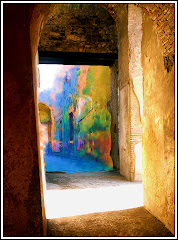
Still it was such a lovely old place: with a grand edifice and superb old world touches...

I played around with this image for a while. But nothing was working until I took a child's face and put it into the corner. This child was a student in a remote school not far from the seriously wild areas of Africa.

I loved Africa. There is something utterly mystical there. Maybe it's a vibrant quality in the air or the exotic nature of the people. Maybe it's the way you can turn a corner on a dusty road and see something amazing...or stand mere feet from an elephant or lion going about their business.

I loved Africa. I loved being there. Part of me still is.

Wednesday, December 17, 2008

Photographing Kids: The Picture AFTER the Picture

I am blessed in many ways. I am married to a splendid woman and we travel the world together. I have a world-class cat. I love what I do for a living and...I am blessed with little people in my life who are happy to pose.

This young lady is one of those people. Here are three pictures from dozens taken during a fifteen minute session on our back porch one summer afternoon.

She has known me since birth. We are comfortable together. But she was still only five years old. In working with "little people" there are a lot of things to keep in mind.

First: you need to keep talking. Photographers have a lot to think about: settings, the subject, the light, the composition. We have a tendancy to want to concentrate on taking the shot and ignoring the subject.

This doesn't work with kids.

You need to keep communicating. You need to keep the child engaged in the process. You need to make them laugh, to look in the directions you want them to look. You need to keep your model engaged in the whole process. There has to be a powerful link to the process between the photographer and the subject.

You need to keep shooting. We (as in the royal "photographer we") have a habit of checking the LCD screen and the histograms to see what we got.

Don't do this when you are working with kids. The idea is to have nothing coming between you and the child. The camera has the potential to become one of those things: it's a big mysterious box to little eyes. Ideally, the camera becomes part of the whole adventure and doesn't represent something scary or misunderstood to the child. In order to keep shooting there are a couple of things that make the process smoother:

1) Do all your settings and camera fiddling before you start with the child. That's important because you need to concentrate on just shooting once the session starts.

2) Use a Burst or Sports Mode. Kids move very quickly and emotions flicker across their faces like vapor. You need to shoot very quickly so you can catch every nuance of what they do.

3) Keep the atmosphere positive. There should be lots of laughter and lots of positive words spoken. The child needs to feel confident and have the ability to relax in front of the camera.

Take the picture AFTER the picture. This is one of the most valuable things I have learned from watching my wife work with people. She's done a ton of portraits. One day I realized how she got such great candid looking shots.

She would take the shot they expected her to take. Just as they were leaving, she'd engage them in conversation and then she would say something funny. When they responded, she would take the shot and she'd consider that the portrait.

It's a technique I have used (okay copied) many times. It works like a charm.

You will get "real person."

And the "real person" is much more interesting than those unnatural posed shots, which are particularly awful when children are in them.

Thursday, November 27, 2008

Passionate Images...

It is nearly the end of another working day. For a special events company, this is "high season," when better than 40% of our year's income will be made. There are many things that should be foremost in my attention.

But I am thinking of our "enchanted forest" instead. You see a faint glimmer of what we (my grandchildren, my wife and me) have seen in the image above. It's a place of twisted trees and mysterious valleys. It's a place where light plays odd tricks on your eye and you are better than 50% positive that a fairy disappeared from view on the very edges of your vision.

When we first brought our grandchildren here, we (my wife and I) were playing a "mixed up story." What's that, you ask? It's a story where the children are on an adventure. It's sort of Dungeons and Dragons for the 'wee folk.' I created this series with the cold-blooded intention of instilling in them the same ache that exists in me: the longing to see the fantastic emerging from the mundane. The "real world" has so very often inspired a sigh in my soul with a longing for something more. I prefer to see something fantastic emerge from the mundane.
That's where the "mixed up stories" come from. The kids take actions...and the actions they take effect the plot.

Does that sound silly to you? Think for a moment about creating a world where invincible skeletons paddle through an acid sea, looking for invaders. It is so very important to me that these kids have the ability to dream! Reality has been a completely unacceptable alternative to me since I was a kid.

We returned to our "Enchanted Forest" at the insistance of our grandchildren. They remembered being here from years ago. We arrived there as the sun was going down. That's when I took the picture that starts this blog.
I became an ogre, searching for "tender young humans" to eat. My grandchildren giggled and ran up a tree. I searched for them stomping through the Enchanted Forest. Finally, seeing them, I launched into my "fee fo fum" rhyme.

They were so very happy in that instant, that it made a lump form in my throat. Our enchanted forest had been so seriously reduced over the years. ("They" are building a subdivision, you see.) Even as I growled after them...I ached for the notion of a place where old trees were NOT torn down to make way for duplexes, where an Enchanted Forest was allowed to stand forever for the kids to play in...and flee from flesh eating ogres.

Part of me grieved for that forest. Once it was populated by twisted trees and valleys. Now it is so very stark and broken and still defiantly glowing.

I think it will glow until the last tree is ripped out by a bulldozer.

At least I hope so.

I truly do. With all my heart.

Wednesday, November 26, 2008

The Eyes Have it

I loved this image the instant I took it. In the first place, this face is very dear to me. In the second place, it's an arresting image. You just want to look at it. Okay…I want to look at it.
There are two versions of this shot. Have a look at them.
It's NOT the same image, is it?
Take a few seconds and look from one to the other and try to decide which one seems more alive to you. Which one do you prefer?
I suspect nine out of ten dentists would prefer the one with the twinkle in it.
Keep in mind that, except for the eyes, this is the same image. One has had a minor eye operation -- and the other hasn't.
That twinkle in the eye is called a "catch light." Really, it's just a reflection of light bouncing off the eyeball. But look at what a HUGE difference it makes to the overall image! Those two little white dots bring the whole picture to life.

Making the transition is easy in Photoshop. The trick is NOT to try to put something there that didn't exist in the first place. If you've ever tried to put a catchlight into an eye you know what I mean. It just winds up looking goofy and way too artificial.
The idea is to take the catchlight that was already there and make it stronger. Here's how to do it in five easy steps:
1) Zoom in on the eye. Photoshop will go to 1600%. This means that you will have a HUGE eye on your screen.
2) Reduce your BRUSH tool to ONE pixel. If this seems extreme to you...please consider you are doing some EYE SURGERY here.
3) Sample the color from the brightest part of the existing catchlight. This is the most effective way to build a bigger catchlight, since you are enhancing what's there naturally. The position is important. Wherever the catchlight was before...is where you are putting the "new and improved" catchlight.
4) Carefully paint ONE PIXEL AT A TIME outward from the center of the catchlight. Remember that you really only need to increase the size of the catchlight a little to effect the transformation.
5) Go to View> Fit on Screen and take a hard look at your image. Does it look better? If so, save under another name (since writing over your original is punishable by severe flogging in Photoshop-aware states and never ever a good idea) and you're done.

While you're working in the eye, you may also want to remove anything there that isn't the catchlight or the pupil. Often subjects will have bloodshot eyes closest to the nose. Use a very light touch with the Clone or Healing tool to wipe them away.

The whole process took me under five minutes on this image. "Eye" think it was time well spent. (sorry...)

Thursday, May 29, 2008

Photographing Kids


Kids are great to photograph, right?
They are unpretentious, they are sincere and -- if you can get the right kid -- they are wonderful subjects.
On the flipside, you need to forge a personal bond with them, some kind of relationship, that allows them to be comfortable in front of a camera and natural in all they do. It's that "naturalness" you are trying to capture in that split second the camera gives you to take the shot.
If you planned to take a picture of an adult, you would take the time to invest yourself in getting to know them, right? It's no different for kids. You need to take time to kibbitz with them, to get to know them and then the great gates of images open.
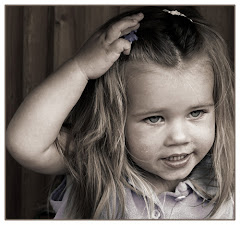
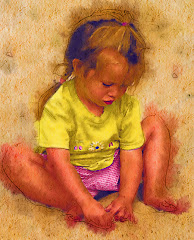
I spent close to half an hour with the child in this picture. She happens to be my granddaugher, but the fact that I was sitting on my porch, taking picture after picture may have served to make the whole picture taking process more difficult. The photographer, whether they are photographing children or adults, needs to realize that the camera itself is a barrier to interacting with the subject. It's a great black block of matter that shows them to the world. While it's true that kids are less likely to flinch in the face of the lens, it's also true that, as an artist, you are looking for a way to present that youthful presence to an audience.
In this particular picture, she was walking away and then turned to say something to me over her shoulder. I captured the image here and so the image is held here in that second.
Take time to understand the subject of your portrait. Try to capture them in that fraction of a second where they show you who they are. Respect them as complete people.
For this picture, I copied my layer and then converted the picture to black and white. Then I worked on the Opacity, reducing the blend between the two to 50%. This adds a nice "hand tinted" look to the photo -- predominantly on the dress and hair highlights.
The picture was then flattened and framed and we're done.