Monday, December 8, 2008

Visual Creativity. Honest.

I don't know of a single writer who hasn't glared at that blinking cursor. It just sits there like an insensitive insect waiting for you to come up with the words while it does nothing except sit there blinking stupidly. It's a tyrant, really.

Visual artists have the same issues. We sit there with our hands in our laps looking at the computer screen. Sometimes we have a germ of an idea that can be developed. Sometimes (okay rarely) we know exactly what to do. But most of the time there's this tickle of a concept at the back of our brains that runs away like an arm-flapping idiot each time we try to trap it.

Peter J, from New York, wrote in to ask if I had any ideas on how to be creative. Later this morning I was on the NAPP board and the same topic came up again.

"How do you learn how to be creative?" asks the Photoshop newbie. "There must be a course somewhere."

Nope. There are courses about creative techniques. Oodles of them. And there are books about getting in touch with your imagination. I mean you could dance naked in the woods and pound on drums for a few days -- but I seriously doubt that you will find yourself with a perfectly formed notion for how to break that creative block. All you may wind up with is a nasty rash.

There are even courses on how you can take an idea and develop it into a striking visual. (Check out "Photoshop for the Creative Soul" at http://www.photoshopbasics.com for our course on this. Hint. Hint.)

But if someone tells you they can teach you how to BE creative, they're lying.

You can be taught how to copy someone else's method. There are tons of Photoshop books that teach this stuff. You can look at an artist like Ben Willmore (http://www.whereisben.com/) and see what he's been up to. I really respect the guy -- and the quality of his work is unreal.

But, personally, I don't want to be Ben Willmore. Why would I want to copy his work? I'm happy to sit and listen as he teaches me stuff -- but only so I can apply said "stuff" to my work.

Why's that?

Because true creativity isn't the result of inspired copying of someone else. You can learn stunning technique this way...but you only learn how to be creative by pouring all that knowledge through the filter of YOU.

True creativity is the direct application of 24 carat, 100% YOU to an idea. Think of it as a one of a kind Photoshop filter: There's only one you. That means there's only one person who can apply imagination and execution to an image that is the direct outgrowth of who you are.

The only way I can suggest for getting creative isn't to take a course. It's to roll up your sleeves, stick your hands into the muck and start pushing stuff around. It's going to be messy. And you are going to have disasters. You will have moments when you want to throw the computer through the window and then follow it (given that you're far enough away from the ground) because NOTHING is turning out right.

I 100% guarantee there will be dismal awful images if you do it this way. You'll delete them, you'll flush with embarassment whenever you think of them. You'll pray that no one you ever showed them to kept a copy...and you'll start putting a little money aside each week in case they DID keep a copy and want to blackmail you with it later.

Being creative and turning that "creative switch" on inside your brain and spirit would be pretty easy if you knew where it was. I often can't find mine...particularly when deadlines are looming. So I have to thrust my hand into a lot of dark holes and smelly caverns as I look for it.

And the real pain in the butt? That damn "creative switch" often disappears minutes later and you have to start looking for it all over again. That's when you think to yourself "Gee...I thought I had a great idea. Where was I going with this again?" Now you have a name for it: Switch Slip.

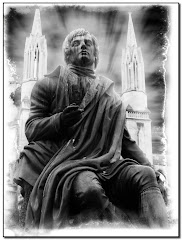
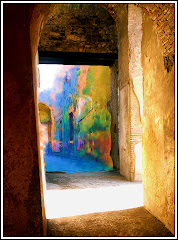
See the image above? I spent four hours on this one day many moons ago. I'd just discovered Photoshop and had a hankering to do..."something." I entered it in a contest and it placed in the bottom third. How come? It's not creative. It's a mess, really. What it lacks in creativity it makes up for in pseudo-artsyness. It has vague ideas about money and fighting on top of it and women.

Yup. It's one of those "I can't believe I posted it ANYWHERE" images. It's pretentious crap. There. I admit it...now I can stop paying off that guy in Germany who keeps getting those installments in small unmarked bills.

What's the upside of this whole creativity thing?

Once in a while...sometimes for a really long time...you feel your spirit soar and your heart beat faster. You feel the blending of mind, spirit and body pouring itself into the project. Your hands blur over the keys or the controls and the sensation is better than a triple fudge sundae.

And less fattening.

Friday, December 5, 2008

Bokeh is Here

"I am absolutely not buying any more filters or plug ins," I told myself as I looked in relative wonder at Alien Skin's latest contribution to the Photoshop universe.

It's called "Bokeh" and is a very easy to use simulation of the effect photographers spend a ton of money on specialized lenses and years of careful study to achieve.

Simply put, it's the selective blurring of portions of the image. This allows the artist to gently draw your attention to the precise area of the image he wants you to see.

Photographers are all a-flutter about bokeh technique because it also has the potential to add atmosphere and mood , create professional looking images and make you look way more skilled than you actually are. (I'm all for that.) It also hints that you have cash to burn, since actually shooting bokeh requires some pretty expensive lenses.

"Can't hurt to download the demo," I told myself with an innocent shrug. "It's only a demo. I'll use it for the thirty days and then I'll delete it. If tempted, I shall simply apply my iron will and remind myself this is simply a learning opportunity." I would have patted me on the back at this point if I could have reached back that far. I settled for squaring my jaw and looking sternly into the computer screen.

"Who's gonna spend two hundred bucks on a lens blur?" I said to myself. Again. I think I may have sputtered just a little in indignation at the very thought. But when I started using this plug-in my reserve started to waver and my iron will developed immediate rust. Bokeh by Alien Skin simulates the effect you'd get using some very specialized glass and it does it so easily that it's hard not to fall in love with it.

I still wasn't going to buy it, you understand. After all, I just upgraded to Photoshop CS4 and bought HDR software. In these times of economic uncertainty, you'd have to be crazy to drop another pile of cash on software, right?


With Bokeh, you can create a "Focus Region" using an oval selector or a planar. Make it big or little. Define the precise amount of blur you want. Set the precise areas of focus. (This is very precise stuff.)

The basic process takes about thirty seconds.

My mind started turning to some of the uses for Bokeh -- on the very off chance I would even consider buying it...not that this was an option I was actually considering, you understand.

Portraits could be softened in an instant. Streetscapes could be created that would allow me to highlight the exact elements I want the viewer to see. Clutter is blurred away. Bokeh would add a whole new dimension to statue and building photography. I could even do campy things like make hearts in the blur area. (Okay. Probably not that.)

At this point I really started to investigate the options. Hugely expensive lenses are simulated flawlessly (I am "using" a Canon EF 50mm f/1.2LII @ f/2 here, which creates a 20% blur).


Use your imagination and pretend that you can source all the lenses in a camera store, pretend you understand precisely how to use them and that you've spent nine years on a mountaintop somewhere with a guru learning the disciplines and techniques of Bokeh. Okay?

Now pretend that you have the ability to take precisely the same shot with each of these lenses and that you know exactly what you're doing to create the bokeh effect you want. Yup. That's a lot of pretending, right?

Like let's pretend that I decided to take the exact same image again but this time I really wanted to highlight my subject...and created a 50% blur with some slight vignetting on the fringes which is the image just above.

Alien Skin's Bokeh starts falling into the "way cool" category pretty quickly.

Two hundred bucks suddenly didn't seem all that expensive. When you've stacked a little pile of money against the many thousands of dollars it would cost to outfit myself with all the necessary cameras, glass, classes and books I'd need to get these shots, two hundred bucks didn't seem too bad at all.

A bargain!

Why I would be insane to pass something like this up! Moreso, it was clearly my duty as a graphic artist to add this software package to my arsenal of visual options. In fact I owe it to the whole freaking world to pick it up!

I emailed Alien Skin, asked if they gave a discount to NAPP members and they took 10% off. Okay. So it's still $179. But I have to say that I am seriously thrilled with the package. Thrilled. I have been working with it for hours and I just keep getting "thrilled-er."

As with all Alien Skin software, the initial use is very simple (which is good because I am a very simple guy) but there are a ton of options and settings that will allow the artist to get the precise effect he is looking for. I haven't even really scratched the surface of what this software will do. But I wanted to tell you about it right away because it's something I really suggest you take a look at.

Download a fully functioning Bokeh demo from http://www.alienskin.com/ and tell yourself that it's only for 30 days and there's no way you will ever buy it.

Yeah. Sure.

Thursday, November 27, 2008

Passionate Images...

It is nearly the end of another working day. For a special events company, this is "high season," when better than 40% of our year's income will be made. There are many things that should be foremost in my attention.

But I am thinking of our "enchanted forest" instead. You see a faint glimmer of what we (my grandchildren, my wife and me) have seen in the image above. It's a place of twisted trees and mysterious valleys. It's a place where light plays odd tricks on your eye and you are better than 50% positive that a fairy disappeared from view on the very edges of your vision.

When we first brought our grandchildren here, we (my wife and I) were playing a "mixed up story." What's that, you ask? It's a story where the children are on an adventure. It's sort of Dungeons and Dragons for the 'wee folk.' I created this series with the cold-blooded intention of instilling in them the same ache that exists in me: the longing to see the fantastic emerging from the mundane. The "real world" has so very often inspired a sigh in my soul with a longing for something more. I prefer to see something fantastic emerge from the mundane.
That's where the "mixed up stories" come from. The kids take actions...and the actions they take effect the plot.

Does that sound silly to you? Think for a moment about creating a world where invincible skeletons paddle through an acid sea, looking for invaders. It is so very important to me that these kids have the ability to dream! Reality has been a completely unacceptable alternative to me since I was a kid.

We returned to our "Enchanted Forest" at the insistance of our grandchildren. They remembered being here from years ago. We arrived there as the sun was going down. That's when I took the picture that starts this blog.
I became an ogre, searching for "tender young humans" to eat. My grandchildren giggled and ran up a tree. I searched for them stomping through the Enchanted Forest. Finally, seeing them, I launched into my "fee fo fum" rhyme.

They were so very happy in that instant, that it made a lump form in my throat. Our enchanted forest had been so seriously reduced over the years. ("They" are building a subdivision, you see.) Even as I growled after them...I ached for the notion of a place where old trees were NOT torn down to make way for duplexes, where an Enchanted Forest was allowed to stand forever for the kids to play in...and flee from flesh eating ogres.

Part of me grieved for that forest. Once it was populated by twisted trees and valleys. Now it is so very stark and broken and still defiantly glowing.

I think it will glow until the last tree is ripped out by a bulldozer.

At least I hope so.

I truly do. With all my heart.

Wednesday, November 26, 2008

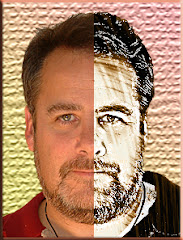
The Eyes Have it

I loved this image the instant I took it. In the first place, this face is very dear to me. In the second place, it's an arresting image. You just want to look at it. Okay…I want to look at it.
There are two versions of this shot. Have a look at them.
It's NOT the same image, is it?
Take a few seconds and look from one to the other and try to decide which one seems more alive to you. Which one do you prefer?
I suspect nine out of ten dentists would prefer the one with the twinkle in it.
Keep in mind that, except for the eyes, this is the same image. One has had a minor eye operation -- and the other hasn't.
That twinkle in the eye is called a "catch light." Really, it's just a reflection of light bouncing off the eyeball. But look at what a HUGE difference it makes to the overall image! Those two little white dots bring the whole picture to life.

Making the transition is easy in Photoshop. The trick is NOT to try to put something there that didn't exist in the first place. If you've ever tried to put a catchlight into an eye you know what I mean. It just winds up looking goofy and way too artificial.
The idea is to take the catchlight that was already there and make it stronger. Here's how to do it in five easy steps:
1) Zoom in on the eye. Photoshop will go to 1600%. This means that you will have a HUGE eye on your screen.
2) Reduce your BRUSH tool to ONE pixel. If this seems extreme to you...please consider you are doing some EYE SURGERY here.
3) Sample the color from the brightest part of the existing catchlight. This is the most effective way to build a bigger catchlight, since you are enhancing what's there naturally. The position is important. Wherever the catchlight was before...is where you are putting the "new and improved" catchlight.
4) Carefully paint ONE PIXEL AT A TIME outward from the center of the catchlight. Remember that you really only need to increase the size of the catchlight a little to effect the transformation.
5) Go to View> Fit on Screen and take a hard look at your image. Does it look better? If so, save under another name (since writing over your original is punishable by severe flogging in Photoshop-aware states and never ever a good idea) and you're done.

While you're working in the eye, you may also want to remove anything there that isn't the catchlight or the pupil. Often subjects will have bloodshot eyes closest to the nose. Use a very light touch with the Clone or Healing tool to wipe them away.

The whole process took me under five minutes on this image. "Eye" think it was time well spent. (sorry...)

Friday, November 21, 2008

Taking Great Candid People Shots


In old English folklore, they said that fairies were the most elusive of mythical creatures. Apparently you could only see them out of the corner of your eye and they would disappear like smoke if you actually looked at them full on.
Great candid people shots are like that. When you head out to the street with your camera in tow, you need to be looking in front of you, behind you and beside you. All your Spidey senses need to be wide awake.
The shot heading this blog is one of my all-time favorites. I took it on a warm summer afternoon at Coney Island in New York City. A minute after I took the shot, they got up and left. So, like the fairies, the shot presented itself for scant seconds.
It's called "A Little Off Center" because these two people seemed completely at odds with the hustle and bustle of the boardwalk. All around them there were guys working out, people swimming, rides twirling -- and yet in the midst of all of this, these two old people just sat together. The man has his arm draped around the shoulder of his bride, his ankles are crossed and there's this wonderful permanent feel that the two of them have. I like the negative space on the bench because it says to me that these two WANT to be sitting close.
Since I tend to consider stuff like this, I wonder if one day he went to war and they've been together ever since he got back. Or maybe they both had lost spouses...or he'd retired after many years in business and maybe they come to this bench every day to sit and watch the people together.
Great people shots are like that, for me anyway. They encourage speculation about the subjects. This image was turned into Black and White because it suited the theme well...and my couple is just a little off center because it worked better visually that way.

This shot happened just a few minutes later. The wind picked up and most of the sunbathers vanished. There was just this older man walking on the beach by himself. I like this shot as well because it has so very many things going on: the vast ocean, the single man, a deserted beach. I like that he uses a walking stick.
Mostly this image speaks to me about isolation and solitude. Here's a guy who is "no doubt about it" taking a walk. There's one bird on hand for company.
What is it about Black and White that creates such a powerful atmosphere? You won't have the same powerful sense about these people if the image is in full color. B&W carries a wonderful moody quality to it. In the case of the second image, I actually added grain. I wanted it to look gritty and liked the texture the extra grain brings to the overall feel of the image.
The other huge advantage of going with Black and White is, of course, the VASTLY improved Black and White adjustment layer in Photoshop CS3 and CS4. This gives you the adaptability to get the exact effect you're looking for.
There are three keys to taking good people shots:
1) Be Present: You need to be alert every instant for your shot. When it comes, don't hesitate. Shoot. If the shot doesn't work out, you can delete it. Relax. It's digital.
2) Consider a telephoto: It's the nature of these shots that some are far away. You won't have time, in many instances, to jog across the street. The telephoto gives you the ability to shoot as soon as you see your picture. It is, obviously, not so great if your subject is close. But they would have to be within just a few feet of you to mess up the focus. It's waaaay easier to step back a few feet than it is to race across a street.
3) These shots can easily be taken without faces. Both of these are stock images. I can and do sell them through agencies. Since the people cannot be recognized, I have no need for model releases or fees paid out. Beyond this, I actually prefer "faceless" images. They invite your audience to put their own spin on the image.
You'll find great people shots everywhere: shopping malls, beaches, parks -- any place people come together.
Give it a try. You never know what kind of gems you'll walk away with. And be attentive. You never know when or where the fairies will turn up.

Wednesday, November 19, 2008

The Picture I Wish I'd Never Taken

Imagine inviting yourself over at someone's house -- someone you don't even know -- eating their food and then complaining about the way it was served. Now try to see yourself making snide comments about their home, the way they dress, what they do for a living. Think about being a real jerk and calling down their whole lifestyle.

Most of us wouldn't even consider being that rude, right? I mean -- it's unthinkable to behave so badly when you're a guest in someone's house.

A tourist is just someone visiting strangers in a really big house.

Take a close look at the image above. This is a street family in South America. The girl with the flowered top sells little boxes of Chicklets to the thousands of tourists who pour off the cruise ships. Mostly she stands on the dock, with a cardboard box raised and a shy smile frozen on her face. Most people walk past her without even looking her way.

Once in a while, someone stops and gives her a dollar for two pieces of gum. Sometimes someone shakes their finger in her face and lectures her about "begging" in a language she doesn't understand, although I suspect their message comes through loud and clear. But mostly, she is ignored.

My wife and I saw her walk back to her mother and little sister. They all sat against a stone wall together. I went over with my camera. I saw a picture I wanted to take: a street family with three clearly defined personalities and I began shooting. I had no second thoughts, no greeting. I just started taking their picture.

The mother buried her face in her youngest child's hair, while the middle child reached for her sister's arm, with this strangely impassive look on her face. In retrospect, what were they supposed to do? I'd like to think I left some money behind once I was done. I honestly don't remember.

But I should never ever have taken the picture. At least I shouldn't have taken it the way I did. Each time I look at the image of these people now, I wonder what they must have been feeling when this tourist from a country far away, pointed a camera at them and started taking their picture, like they were particularly interesting fire hydrants or buildings. There's a little pang of guilt each time I see it. Okay. A BIG pang of guilt.

In North America, we are the world's blessed people. We don't depend on selling a few mini boxes of Chicklets to survive. For most of us food and shelter have ceased to be issues. That's why we have the income to travel like we do. We consider poverty not being able to afford a new car or a plasma screen television. There are people -- many of them really small people -- who are literally just trying to get get enough to eat.

It was some years later when I came across this image that I started thinking about what I had done. I'd treated three people like "un-people." I'd been an Ugly Tourist. Yikes! That's a hard thing to admit to myself, let alone publish in the blog.

Since then, I have developed Five Rules For Visiting Other Places Without Being A Jerk.

1) If You Wouldn't Say It in Front of Your Host at Home, Don't Say It. Tourists often think that people in foreign countries can't understand what they are talking about. I've seen people say very nasty things about the place they're in, the food they're served or the behaviour of the "locals." Trust me. These people know. They spend their lives watching tourists. They know who you are. Be nice.

2) Try to Speak the Language. My Italian is horrid. I clearly remember being urged by my wife to ask a complete stranger on a train where our hotel was. I spoke in my halting Italian and watched as a very kind light came into her eyes. She at least knew I was trying. (She answered my question in near perfect English, by the way.) But I'd shown some respect for where I was visiting and that meant something to her.

3) Enjoy The Ride. Why do we travel? We want to see different places and different people, right? Don't get bent out of shape when things don't go your way. If it rains, it rains. If the taxi breaks down -- yelling at the driver accomplishes nothing. I've seen tourists rag on tour guides because the weather sucks, or there are too many bugs or the line-ups are too long. What must they think of us? My wife and I will often look at each other, smile and shrug and say something like "It's travel." So relax. It's all part of the trip.

4) Pay a Couple of Bucks For The Picture, Okay? Two or three dollars might not be much to us. It can be a whole lot more for third world families. Stop and smile. Raise your camera and ask if with your eyes if it's okay to take their picture. Give them a little money. You'll be amazed at what good models they can be. It's a great trade-off. You get a memorable image, they get some cash. I would be able to look at this image with pride if I'd done that...and I probably would have met some cool people. (A little further back in this blog I've written about one of those life-transforming experiences involving me trying to photograph a street person.)


5) Buy the Freaking Chicklets. I don't think I will ever see that kid again. But I won't pass the Chicklet vendors by again. There is, of course, a small risk here. Once the other kids see a tourist passing out money -- you run the risk of getting swamped. That's why I will have a couple of singles in my pocket, ready to go. I can very quietly give the money to one child and move on. I read recently about another traveler who gives out small toys and pencils to the kids. This is a great idea...except that you can't eat a pencil.

I keep thinking: "What must we look like to them?" Wave after wave of bloated tourists roll off the cruise ships waving Visa cards like swords and finding fault with everything around them.

On my first day in Jamaica, I asked the bartender for bottled water. I thought that was what we were supposed to do and frankly I didn't mean any insult. I remember the snapping anger in his eyes. It was there for just a moment and then he masked it by polishing the glasses in front of him. He muttered that there was nothing wrong with Jamaican water...but he gave me a bottle all the same.

It's about being a gracious guest. When you visit someone for dinner, you take a bottle of wine, right? Maybe some flowers...or a dessert. I've been on enough trips now where I am really starting to view myself as a guest in the country I'm visiting.

Try it.

You'll get better pictures, your travel experiences will be much richer and you will never look with shame upon the picture you should never have taken.

Our power is the money we bring. And we have this power because they are poor. But we are going to their homes. And I'd really rather be a welcome guest instead of a jerk.

Tuesday, November 18, 2008

Thinking About the Big Easy

This morning I wrote an article on "The Difference in New Orleans after Katrina." Since this blog is about travel, photography AND Photoshop, I want to share it with you.

The sun is warm on my skin and the air is ripe with the exotic scents of the Big Easy: green growing things, cigarette smoke and spilled beer.

We are in the French Quarter, watching the sun come up. I am seized by the notion that the atmosphere surrounding me is an odd blend of things manufactured for the tourists who choke these streets every night and a very real thing, an etherial "something" that is so uniquely and perfectly New Orleans. That mystical atmosphere is all around us, coiling around our spirits like an affable snake.

My wife and I have been here before. Ordinarily we avoid the Quarter. It has an ugly wild side. One evening there during our only Mardi Gras was more than enough. But mornings here are different. There's a lazy feeling in the Quarter, and it feels like watching a cat take a long stretch after a nap in a sliver of sunlight.

I nod to a man standing idly by a convenience store, smoking and drinking. I wonder if he has been out all night. He barely moves his head in response but I feel his red eyes on me.

"Morning," I say.

He takes a long draw on his drink.

"Morning," he says finally. The voice is deep, created with whiskey and smoke as much as genetics, I decide. There's suspicion in his eyes and a distant hostility there too. He turns and walks away from us, his steps uncertain. He is carrying himself with as much dignity as a man at the tail end of an all-nighter can muster.

I watch him walk away feeling every inch a tourist with my camera around my neck and my clean clothes. I will think back on this brief encounter many times over the next few days because that man personified the feeling I get as visit New Oreans for the first time since the storm came calling. This time, there's an attitude of waiting, a faint resentment and an underlying sense of betrayal from the people.

Later that day, we have scheduled a bus tour of the areas of New Orleans ravaged by Katrina.

We file onto the bus with the other tourists, cameras poised, and listen as our guide mirrors the same attitude as the man outside the convenience store.

"You been to the Quarter?" he asks. "How many you been to the Quarter?"

Everyone puts up their hand.

"When Katrina came, it barely touched the Quarter. We gonna see the places it DID touch."

The bus winds its way into a different New Orleans. The highway is something like a time machine because we leave the lights and siren songs of the tourist areas and head into devastation. Dozens, maybe hundreds, of houses are ripped open like fruit dropped from a great height.

Debris lies in oddly indifferent looking piles on either side of the street. Street lights are gone and I have the sensation of going into a third world country were half naked children will sell you Chicklets as their mothers look on with hungry eyes from a distance.

There are odd markings on many of the houses, numbers spray painted inside the frame of an "x."

"This tell the rescuers how many people in the house," says the guide. "Sometime it tell them how many died in there. Sometime it tell them what houses gotta be torn down."

The guide's attitude is reserved. I keep getting the idea that he is showing us something very private and he is conflicted about it.

He tells us about how many people ignored the warnings that devastation was rumbling their way because they got warnings all the time. He tells us about people who drowned in their own attics because they failed to take something with which to cut a hole in their roofs when the water came for them. He tells us about the levees in which they had trusted that fell like tinker toys before the fury of the storm.

Finally he tells us about how they had believed in a government that would come and help in times of great need...and how they were still waiting.

What's the difference between pre and post Katrina? It's not the horror of the destroyed buildings. Nor is it the devastating death toll. It's the people.

Katrina ripped into the collective heart of New Orleans and turned a genuine "glad to see you" smile into something much darker, jaded and distantly desperate.

For the balance of my time there, I really sense a different New Orleans. Something seems forced, like a willful denial that life there can never be the same again. It feels to me, with an inward twinge, as though I am no longer in the "City that Care Forgot." I think deep inside, that the carefree city was sucked into a vortex of indifference and death and will never ever be seen again.

Of couse I hope I am wrong.

I truly do.